BLE VS. UWB TECHNOLOGY COMPARISON
WHEN IS BLE MORE PRACTICAL FOR B2B TRACKING?
While Ultra-Wideband (UWB) delivers maximum precision for centimeter-level niche applications, Bluetooth Low Energy (BLE) sets the standard for cost-effective B2B tracking: BLE leverages existing IT networks without costly antenna cabling, provides up to 10x longer battery life, and reduces total cost of ownership (TCO) for facilities by more than 60%.
When introducing Real-Time Location Systems (RTLS), developers and project managers often face the question of which wireless standard best meets their requirements. In many cases, the decision boils down to a duel: ble vs uwb. While both technologies enable wireless tracking, they differ significantly in cost, complexity, and precision.
The choice between the two systems depends primarily on the required accuracy and the budget.
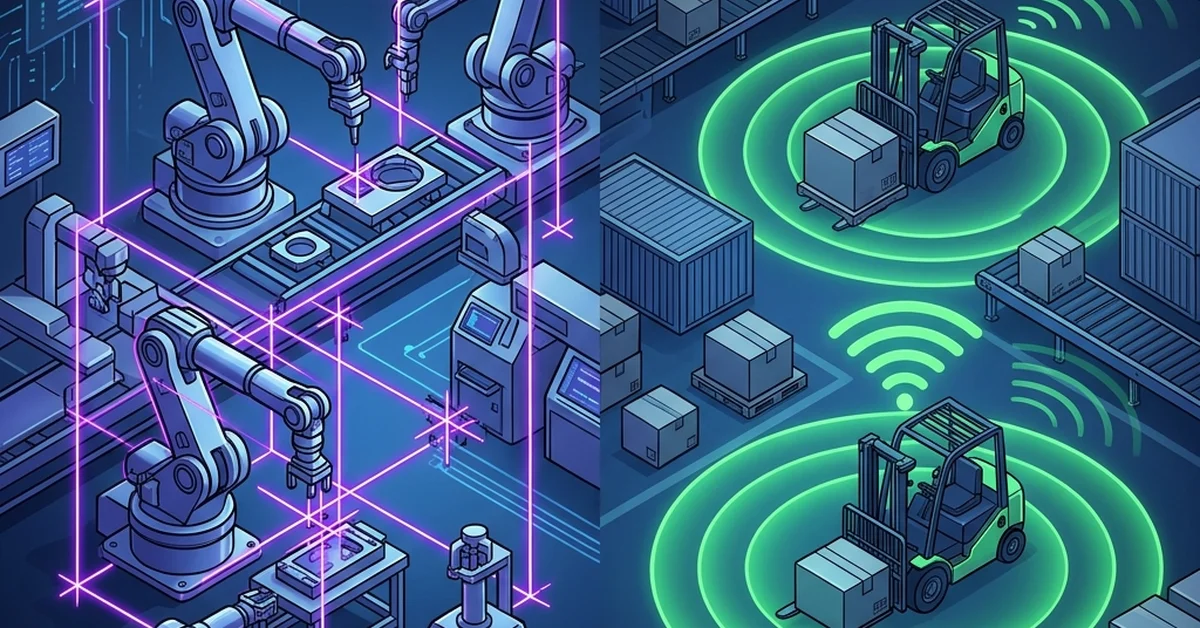
- BLE (Bluetooth Low Energy): Is the economic choice for large-area hall tracking, for zone-accurate and position-accurate asset tracking. It shines with extremely long battery life and low infrastructure costs.
- UWB (Ultra-Wideband): Is ideal for special applications where general, full-area, centimeter-accurate calibrated tracking is mandatory. Typical examples are the control of automated guided vehicles (AGVs), safety-critical processes, or precise tracing of flexible and individual assembly steps directly on the production line.
The ble vs uwb technology comparison in detail
To identify the best option for your intralogistics or production, it is worth looking at the technical differences.
1. Accuracy vs. Cost-Efficiency
UWB offers physical accuracy in the centimeter range (below 10-30 cm). However, this requires a dense receiver infrastructure and exact calibration of the antennas. BLE, on the other hand, achieves stable position accuracy at the required spots – delivering reliable edge positions for locating skeleton containers, boxes, or tools at a fraction of the cost.
2. Installation Complexity (Zero-Calibration)
A central advantage of Safectory BLE solutions is the principle of ‘Zero-Calibration’. The beacons and gateways can be mounted without tedious mathematical calibration of the halls. UWB systems are much more sensitive and require precise 3D calibration of each individual anchor.
3. Battery Life of Trackers
BLE beacons transmit with extreme energy efficiency. Therefore, batteries often last 5 to 10 years without any maintenance effort. UWB tags consume significantly more energy due to wideband signals, leading to shorter charging or replacement cycles.
Conclusion: Pragmatism Beats Maximum Precision
In most B2B use cases, BLE is the more sensible choice due to easier scalability and faster Return on Investment. UWB should be deployed selectively where centimeter-level decisions determine process errors.
We are happy to support you in choosing and combining the appropriate technology. Just write to us at info@safectory.com.