
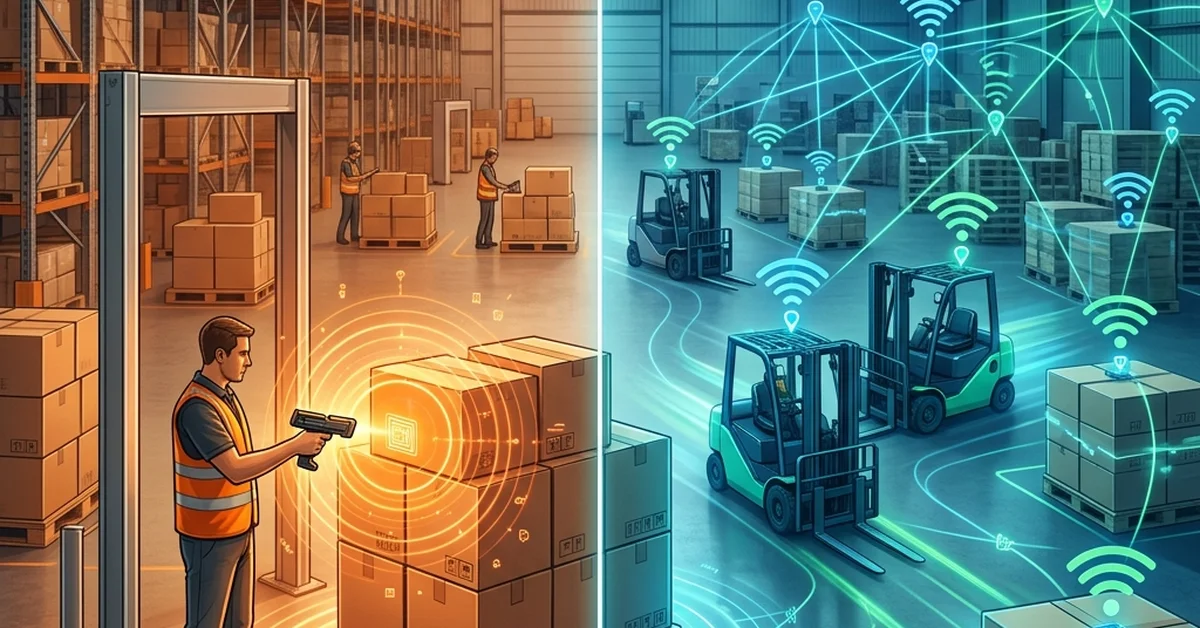
Choosing the right tracking technology is crucial for the success of industrial and logistics projects. Two of the most commonly used technologies are often compared: BLE vs RFID. Both systems offer specific advantages that vary depending on the area of application and process structure.
What is the Difference Between BLE and RFID in Asset Tracking?
The fundamental difference lies in the capture method and tracking dynamics of the systems.
- RFID (Radio-Frequency Identification): Identifies assets at specific checkpoints when passing a reader’s antenna. This technology is therefore ideal for defined checkpoints such as goods receiving or dispatch. However, it requires physical proximity to the reader.
- BLE (Bluetooth Low Energy): Continuously transmits signals and enables permanent real-time location tracking (RTLS) completely without manual scans. This makes BLE ideal for ongoing tracking of equipment in production and intralogistics.
In practice, both technologies do not exclude each other at all. Many modern companies rely on a combined solution to cover both checkpoints and open areas optimally.
The Core Advantages in Direct Comparison
To make an informed decision for your business, you should look closely at the specific characteristics of both approaches.
1. Range and Tracking Depth
While passive RFID tags can only be scanned over short distances, BLE beacons offer ranges of up to 100 meters. As a result, a BLE infrastructure covers entire hall areas seamlessly, which is mandatory for comprehensive asset tracking.
2. Installation Effort and Flexibility
BLE systems operate on the principle of ‘Zero-Calibration Simplicity’ and can be installed quickly via plug-and-play. In contrast, RFID gates often require complex cabling and antenna adjustments at the gates.
3. Cost and ROI
Passive RFID transponders are extremely cheap and suitable for very large quantities of single-use assets. BLE beacons are more expensive to purchase but amortize quickly through the complete automation of search processes without manual labor steps.
Conclusion: The Mix Makes the Success
In summary, BLE dominates when it comes to recurring objects or load carriers and you require continuous real-time visualization of your workflows.
Do you want to find out which technology fits your processes best? Contact our experts at info@safectory.com for a tailored consultation.