
Secure BLE Infrastructure
Safety and HSE: Lone Worker Protection (PNA)
A hardened BLE infrastructure provides the resilient backbone for all indoor positioning, lone worker safety, and industrial RTLS workflows. Operating with ultra-low power consumption and zero-calibration deployment, it guarantees dependable sub-second tracking and seamless alert management.

Lone Worker Protection and Regulatory Compliance
In high-risk work environments, personnel safety is the top priority. Our secure BLE infrastructure, together with Ascom software and hardware, provides a reliable foundation for Lone Worker Protection (PNA) systems. By integrating personal emergency signal devices, we ensure that in critical situations—such as a fall or a manual distress call—the employee’s exact location is transmitted within seconds to the alarm server. This drastically shortens the rescue chain and ensures compliance with international health and safety (HSE) standards.
Certified Security for Critical Infrastructure
In partnership with Ascom, Safectory delivers a solution optimized for alarm-relevant environments in hospitals, industrial plants, and correctional facilities. Our monitored secure BLE infrastructure for RTLS detects sabotage attempts or technical failures immediately, reporting them to the central management platform. This maintains the readiness of safety systems at all times while minimizing organizational liability and legal risks.
Real-time Evacuation Headcount
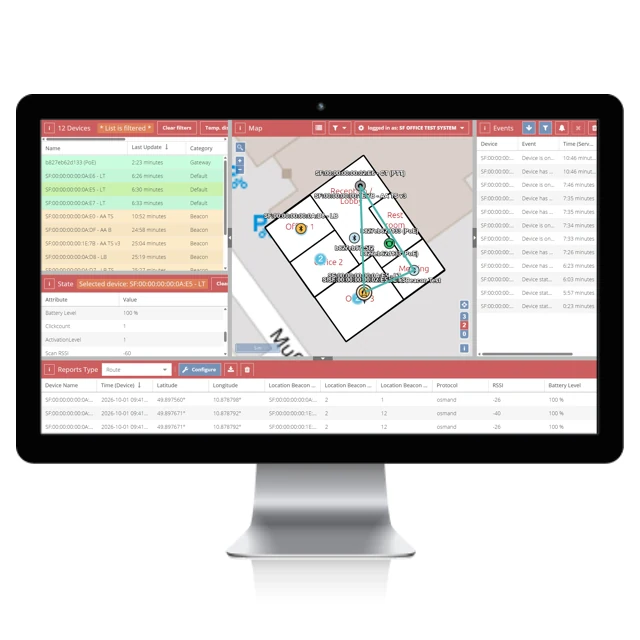
During a building evacuation, every second counts. Our RTLS enables a precise real-time evacuation headcount. Safety officers can instantly see how many people remain in hazardous zones and direct rescue teams with surgical precision. This significantly enhances the efficiency of emergency response protocols and provides maximum transparency in crisis situations.
FAQ – Frequently Asked Questions
BLE asset tracking simple, secure and scalable
Easily track assets in hospitals, factories and secure facilities, integrating with existing infrastructure.
Managing battery replacement across large-scale deployments with thousands of assets is a key operational consideration. Actual BLE beacon battery life depends on battery capacity, broadcast interval, and environmental conditions.
Typical Battery Lifespan Overview
- Standard Asset Beacons (CR2477 Coin Cell): 3 to 5 years at a standard 1–2 second broadcast ping rate.
- Industrial Long-Life Beacons (Li-SOCl2): Up to 8 to 10 years in continuous industrial operation.
- Smart Power-Saving Mode: Integrated motion sensors place beacons into sleep mode when assets are stationary, extending battery life by up to 40%.
Automated Battery Monitoring
The Safectory RTLS Dashboard automatically monitors voltage levels across all active tags. When capacity drops below a defined threshold (e.g., 15%), automated maintenance alerts are triggered. Read more about Bluetooth battery standards at the Bluetooth SIG Developer Portal.
When selecting an industrial location tracking system, B2B companies often compare BLE vs. RFID asset tracking. While both technologies track equipment, carrier assets, and tools, they differ fundamentally in operational mode, range, and infrastructure complexity.
How Does RFID Work in Asset Tracking?
Passive RFID tags (Radio-Frequency Identification) carry no internal battery. They remain dormant until energized by an RFID reader’s electromagnetic field. RFID is ideal for chokepoint detection, such as receiving gates, shipping docks, or designated transfer stations where assets must be logged at specific checkpoints.
How Does BLE (Bluetooth Low Energy) Work?
BLE beacons actively broadcast radio signals at regular intervals. Fixed anchor points or existing Wi-Fi access points (such as Aruba Wi-Fi 6 APs) receive these signals and calculate real-time positions. This enables facility-wide continuous tracking across large factory halls, warehouses, and outdoor yards with ranges up to 100 meters – without manual scans.
BLE vs. RFID Feature Comparison
- Tracking Mode: BLE provides continuous real-time indoor positioning. RFID provides discrete timestamped checkpoint scans.
- Coverage & Range: BLE covers up to 100 meters per access point. Passive RFID ranges from a few centimeters to 5–8 meters.
- Infrastructure Setup: Safectory BLE leverages pre-existing network access points (Zero-Calibration). RFID requires installing dedicated gate frames, readers, and antennas.
- Search Time & ROI: BLE eliminates search time for misplaced tools or container assets via live map visualization. RFID only indicates the last gate an asset passed.
- Hybrid Deployment: Modern smart factories frequently combine both: RFID for automated gate receiving and BLE for floor tracking.
When is BLE Better Than RFID?
When you need to track mobile assets continuously in dynamic environments (e.g., containers, pallets, or mobile equipment) without human intervention, BLE is the superior technology. Technical specifications can be reviewed in the official Bluetooth SIG Documentation.
When selecting a Real-Time Location System (RTLS), decision-makers frequently analyze BLE vs. UWB positioning. While Bluetooth Low Energy (BLE) focuses on cost efficiency and leveraging existing Wi-Fi hardware, Ultra-Wideband (UWB) delivers sub-meter precision.
How Does UWB Differ From BLE?
Ultra-Wideband utilizes wide radio frequency spectrums to measure signal Time of Flight (ToF), achieving positioning accuracy of under 10–30 centimeters. However, UWB requires specialized, high-cost anchor hardware and consumes significantly more battery power on tracking tags.
How Does BLE Compare?
Modern BLE 5.1/5.2 with Angle of Arrival (AoA) delivers accuracy under 1 to 2 meters – perfectly suited for 95% of industrial B2B use cases, including container tracking, tool localization, and pallet management. BLE stands out with 60–70% lower hardware costs, tag battery life up to 10 years, and compatibility with Aruba access points.
BLE vs. UWB Decision Guide
- Precision: UWB for sub-meter autonomous guided vehicle (AGV) control (< 30 cm); BLE for room, zone, and shelf-level tracking (1–2 m).
- Infrastructure Cost: BLE utilizes existing access point infrastructure, drastically reducing deployment expense.
- Battery Life: BLE beacons last up to 10 years; UWB transponders require frequent recharging or battery replacement.
- Scalability: BLE easily scales across sprawling production facilities and outdoor yards. Review technical standards at IEEE Standards Association.
Before investing in an enterprise-wide RTLS rollout, engineering teams prefer evaluating performance in their own operational environment. The Asset Tracking Demo Kit provides a simple plug-and-play evaluation package.
What is Included in the Safectory Demo Kit?
- Pre-Configured BLE Beacons: Selection of industrial beacons ready to attach to sample assets.
- Mobile Gateway / Anchors: Pre-configured receivers for instant setup without touching corporate IT networks.
- Cloud Dashboard Access: Full access to the Safectory RTLS Dashboard featuring live map visualization and tracking analytics.
How Fast is Deployment?
Setup requires zero network integration or complex cabling (Zero-Calibration). Simply power on the hardware, attach beacons, and view live tracking data within 30 minutes.
Learn more
Looking for the best BLE-based RTLS that respects data privacy and doesn’t overload your IT stack?
Discover demos, use cases and technical details.
Technical Setup
Flexible Data Transfer: Gateways or Existing Access Point Networks
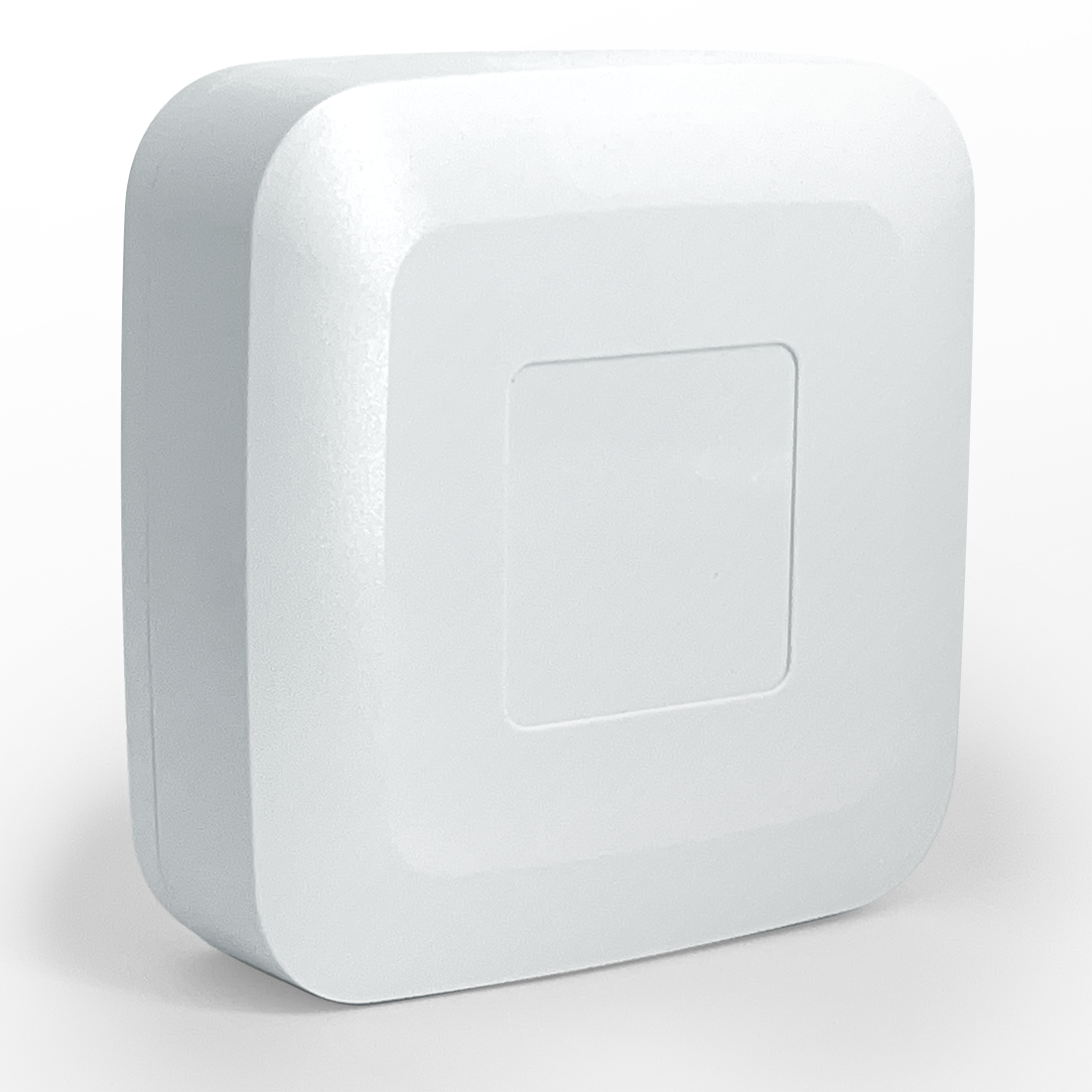
Data acquisition and transport can be deployed via dedicated Safectory IoT Gateways or directly integrated into existing enterprise Wi-Fi Access Point networks (including Aruba, Extreme Networks, and Cisco). This infrastructure synergy eliminates costly rewiring, simplifies enterprise IT governance, and drastically reduces deployment overhead.
Versatile Data Interfaces: REST API (Swagger) & Live WebSockets
Seamless connectivity to third-party host systems, industrial MES/ERP platforms, or safety dispatch centers is supported out of the box: a comprehensive REST API with interactive Swagger documentation for structured queries and device configuration, alongside high-throughput Live WebSockets for sub-second real-time event streaming and live telemetry.
Deployment and Maintenance Tools: Config App and Operational Monitoring
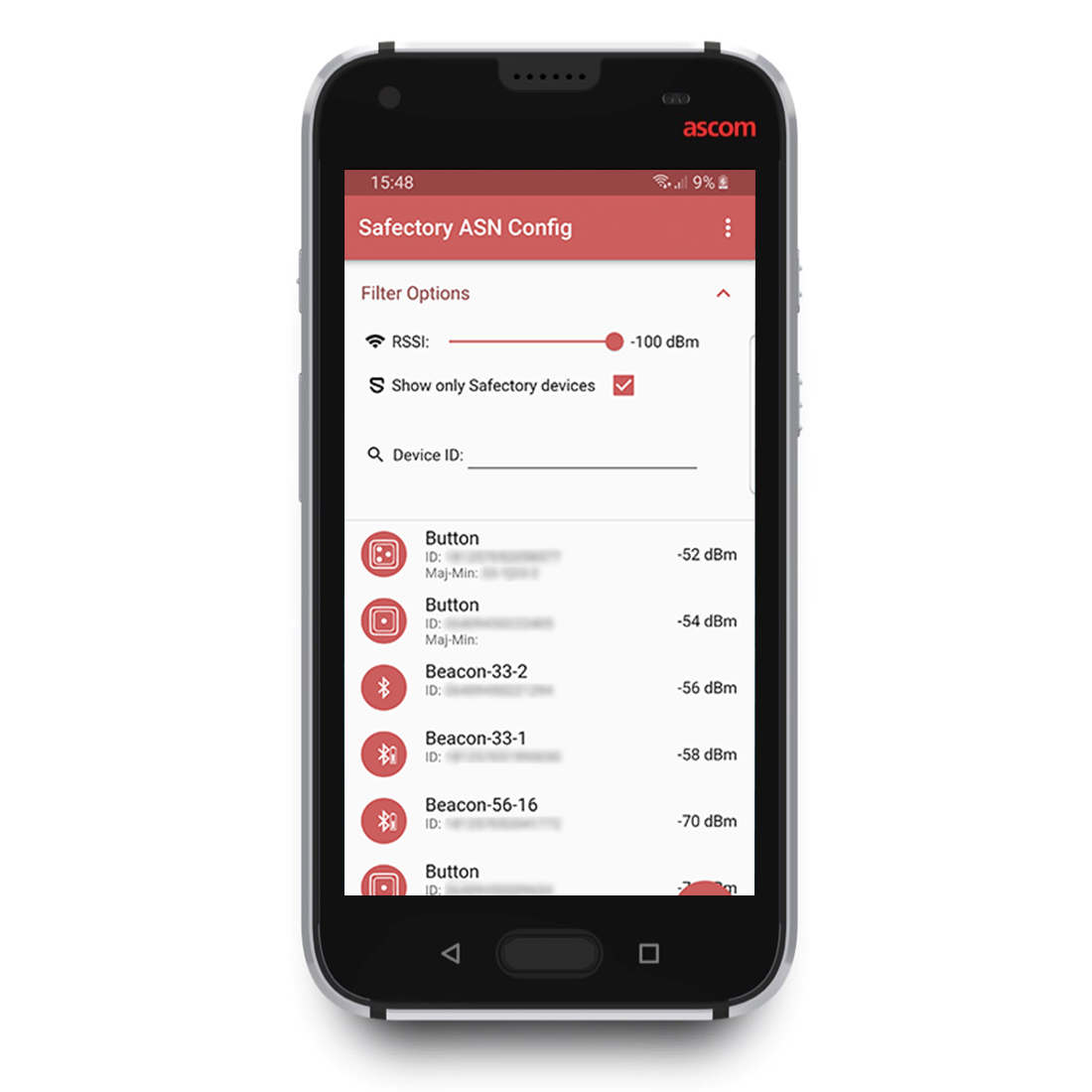
Commissioning and continuous system health are managed through dedicated operational utilities: the mobile Safectory Config App enables rapid on-site beacon rollout and parameter adjustments, while automated monitoring tools continuously verify device status, battery levels, signal integrity, and maintenance operations.
Tip for system integrators: Learn how to manage BLE beacons on site with the Safectory ConfigAPP and what matters when choosing an RTLS.

Safectory partner Ascom
„Zuverlässige Lokalisierung von Mitarbeitenden in Gefahrensituationen“
Von Ascom werden spezialisierte Kommunikations- und Workflow-Lösungen entwickelt, die auf die Bedürfnisse kritischer Einsatzbereiche wie Gesundheitswesen, Industrie und Sicherheit zugeschnitten sind. Mit einem Fokus auf mobile Kommunikation, Alarmierung und Echtzeitdaten unterstützt Ascom Unternehmen dabei, sichere und effiziente Arbeitsumgebungen zu schaffen.
Durch den Einsatz der Ascom-Lösungen können Arbeitsprozesse besser koordiniert, Reaktionszeiten verkürzt und die Mitarbeitersicherheit erhöht werden. So entsteht eine vernetzte Infrastruktur, die reibungslose Abläufe ermöglicht und die Qualität der Entscheidungsfindung nachhaltig verbessert.


Further Solutions

Optical and Wireless Visitor Counting
Zone and Occupancy Analysis
Path and Dwell-Time Analytics



Precision cattle tracking
Animal welfare and activity
Rugged barn infrastructure